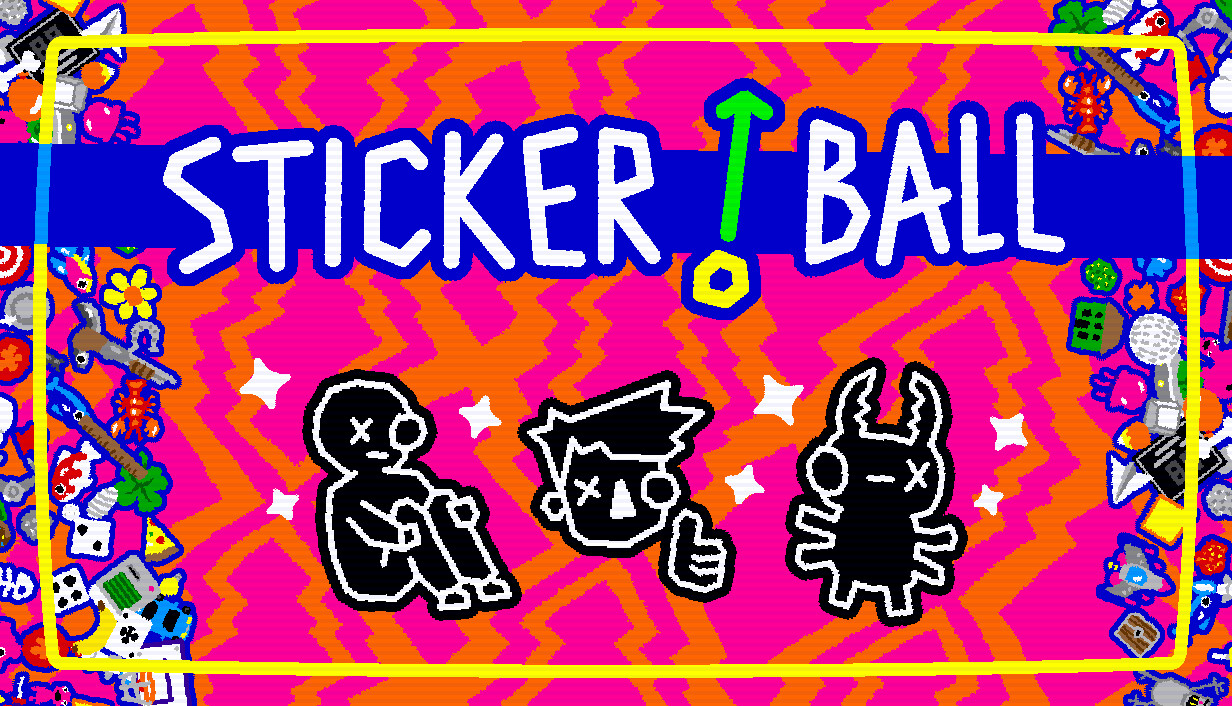
STICKER/BALL is a ball-bouncing roguelike where a house sticker spawns a human, a skiing sticker spawns a yeti that eats the human, and somehow this is the entire game, and it rules. It opens with no tutorial, no explanation, nothing but a menu with a start button you can click to play a match. You fire balls, they hit dice, and you get points. The concept sounds pretty simple until you start picking stickers to place on the dice. Stuff like a spider, which will spawn a web when that side of the dice is hit. It starts with one or two stickers, and then you have a fully stickered-up dice, wondering why the game just spawned a yeti and why your humans are now rioting against police. It’s honestly a unique experience I’m glad I get to talk about.
STICKER/BALL is a solo release from a developer named Bilge, someone who has released quite a few indie projects on Steam ever since early 2018. There’s something about Bilge that is unique to me in how games are developed, as the only other game I discovered I owned by them was a game called Stikir, which I guess is ironic when you consider this game a sticker game. I wonder if Bilge did a crossover between the two, would it be STIKIR/BALL? The reason why talking about older games is important for this review is that one of the stickers in the game quite literally gives you bonus points based on how many games by Bilge are detected in your Steam library. So what really is STICKER/BALL outside of the energy it has?
The STICKER/BALL Core
The core loop is a classic brick-breaker, but without actually breaking bricks (or dice in this case). Instead, you fire balls, bounce them around, hit things, earn points, and if you have a set of stickers on the dice, create a special modifier based on what that sticker does. A single die might have a house sticker, player sticker, skiing sticker, pay-to-win sticker, tape sticker, and truck sticker all spread across the 6 sides. It’s all a game about setting up chain domino reactions across six-sided objects using stickers of poop, trucks, weather reports, downloads, and more in order to hit a friend goal in the top left of the game screen.
Each time you hit a score goal, you unlock a new die. You can’t sticker up the newly unlocked die in the same round you got it when the store page shows up. Instead, you have to wait until you are able to hit the second die in-game before you can kit it up, so if you have a synergy you wanted to go for and it shows up in that first shop, expect to cram it all onto one die.
Below you can see an image I took of the game early on. It’s not the biggest setup ever, but you can see, based on the outline, I’m able to hit the first die 8 times, potentially spawning two humans or more, depending on RNG, then three chances of also hitting and spawning a player review. I think the image alone is captivating because there are so many swiggily lines showing up, where if you showed it to someone who had no clue what you’re playing, they’d be heavily confused.
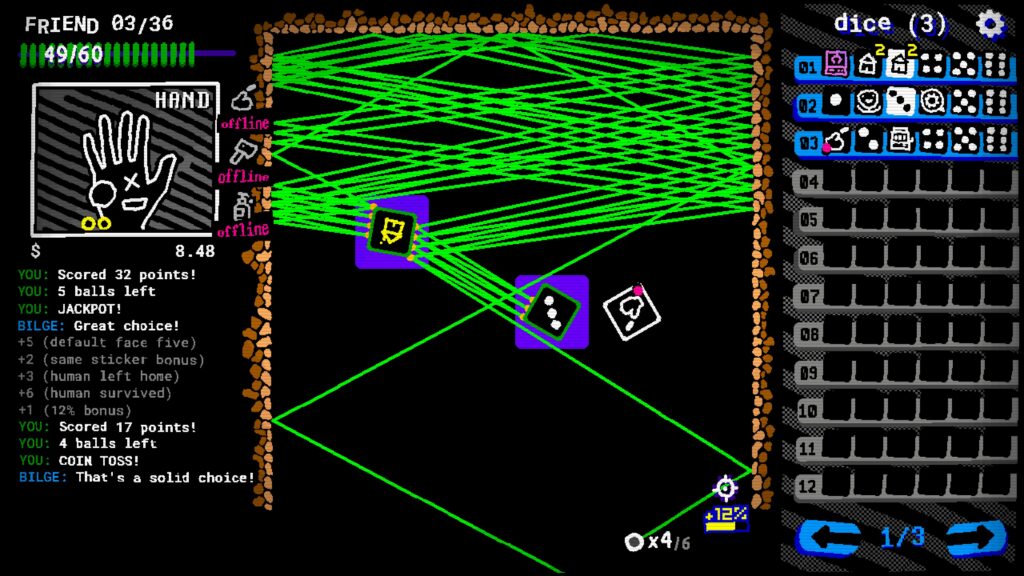
I honestly spent my first run clicking stickers I thought were goofy based on the name or description instead of actually understanding how they worked and what they meant by “+12 for a human.” It wasn’t until I hovered over another sticker and saw “House spawns a human” that it clicked for me, and I realized what must be done.
You don’t have to engage with any of this analytically if you really don’t want to. Grabbing stickers based on vibes and avoiding the ones that look overly complex is a completely valid approach, and the game is still fun that way. For the people who want to dig into how it all connects and make game-breaking synergies, you have a whole world to uncover here, and finding a combo that fires off exactly as planned is very satisfying.
The Pacing and Feel
Runs are short by roguelike standards. Getting from stage one to stage seven took me around ten minutes in one run, while another run took around 20 minutes to get to stage 10, obviously with some time being spent on brainstorming the best upgrades to grab. There are 36 total stages in the game, and I haven’t cleared it yet, but the short run length means the restart cycle never feels too punishing. You’re back in immediately with whatever you learned from the previous attempt and new potential upgrades based on how far you got last time.
The music fits the experience in a way that’s harder to describe than you’d expect. It’s relaxing and similar to lo-fi but with its own texture. Maybe like, chill work music on a rainy day type of relaxing. It’s the kind of thing that you stop hearing a few minutes in as if it were natural background audio, but the moment it is paused or ends, you instantly notice. It just works so perfectly and never begins to feel too repetitive or annoying.
A Note on Save Data & Game Verdict
The game is captivating enough that I installed it on my Steam Deck to keep going on the go, only to find out it currently doesn’t support cloud saving. Progress on your Deck won’t carry over to PC and vice versa. For a game with runs this short, losing early progress is barely noticeable, and you can pick up where you left off pretty easily due to having a better understanding of synergies, but it can be a sore spot for those who may travel a lot and want to play on multiple devices.
UPDATE: Earlier today, Bilge confirmed that cloud saving is already on the list of upcoming features when asked by another user in an update post.
“Thank you, glad to hear that you liked it!! Steam cloud is already on my list :)”
In conclusion, STICKER/BALL is a genuinely weird little game with a real system hiding underneath the surface of poop stickers and bouncing balls. If you’re the type of person who’s searching for a review for this game, then yes, it’s worth your time. It has me captivated in a way that I haven’t felt that captivated since recent indie hits like Balatro and Nubby’s Number Factory. You can pick STICKER/BALL up on Steam today for $7.99 USD when it’s not on sale; however, if you purchase it before May 18th, you get a 30% off sale, making the game only $5.59 USD!