
If Balatro scratched a specific itch for you with that feeling of taking a card game you already understand and having the rules systematically broken apart to rebuilt the concept into something wilder, then Apokerlypse is probably a game that should be on your radar. It takes the classic objectives and terms for a lot of card games and mashes them together. You take the concept of the shedding card game which has the objective of getting rid of all your cards and then you bolt a roguelike deckbuilder on top of it with Poker terms and Solitaire card stacking. With a collection of chips, skills, card enchantments, and different characters who have unique play styles, you get a genuinely interesting concept. The execution, at least right now with the games launch, still has some work left to do.
What is Apokerlypse Actually Doing?
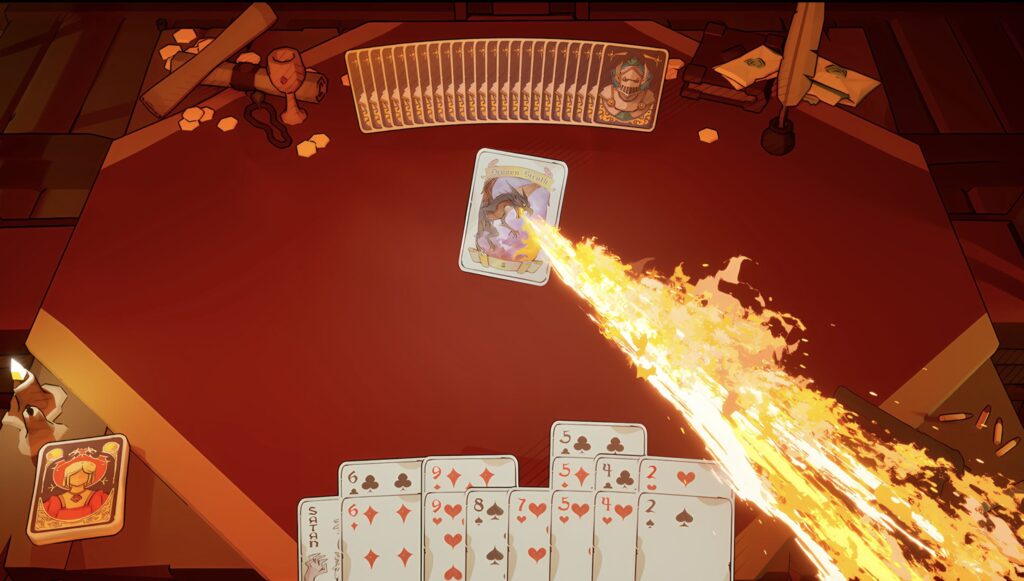
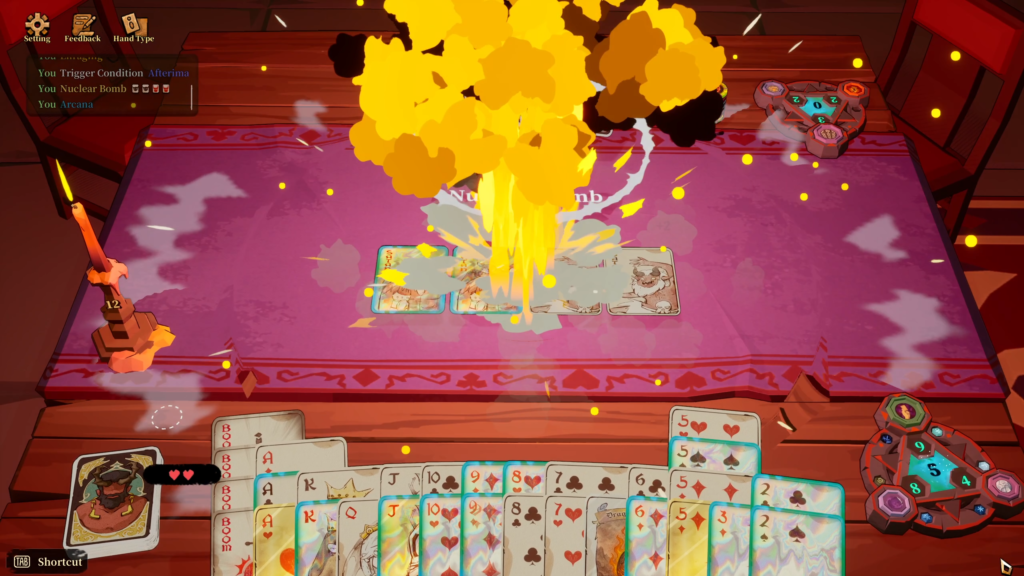
The core loop, despite being named with “Poker” in the title, is built around shedding. You have the goal to empty your hand of cards to win, but almost everything traditional about that format gets thrown out pretty quickly once skills and chips start entering the picture. You’re dropping abilities almost every other turn, building chain reactions, playing “Nukes” as card combinations, and trying to put together combinations that let you blow through your deck in increasingly ridiculous ways. It’s closer in spirit to something like Slay the Spire then it is to any actual poker variant, and the roguelike progression between runs gives each attempt its own flavor depending on what you pick up.
Each hero has a distinct skill and chip pool that changes how each run gets approached. The Queen, for example, leans into dragon-based synergies. After some experimenting on my own I found a combination early on that allows the fire dragon to convert cards into void cards rather than burning them outright. Void cards don’t count towards the “remove all cards” goal, so they can sit in your hand harmlessly while still being available for combos. It’s the kind of discovery that makes you feel like you’ve already broken the game and got a god run, even though I still did end up losing my run due to some poor late game card combination judgment. This allows for unique depth that causes players to spend time learning the system instead of just instantly going based on long-known rules seen in your traditional card games.
There’s also an async PvP component where your opponents in single player are built from real players’ data and strategies, which is a neat concept because it means even when you’re playing in a solo run you get a vibe of playing against an actual human rather than a fixed AI pattern. I didn’t know this when I first went into the game, so I was confused if I was playing against real players or not based on the names and profile pictures alone for some opponents, with one just having the steam logo. The game also supports online play with 2-3 other players, with 4-player mode currently in development.
The Rough Edges
Here’s where things get complicated. Apokerlypse launched with a noticeable localization gap. The logo on first boot appeared to be in Chinese, several in-game strings weren’t translated into English yet, and the achievements are completely untranslated, meaning when you unlock one you have no idea what you actually did to earn it. For a game trying to reach an international audience this is a real friction point, especially in the early hours when you’re still trying to understand the system and then suddenly have to also decode the interface.
There were also some mysterious frame drops when opponents used certain abilities, and my first non-tutorial loss left me confused about the win condition. The opponent appeared to pass on the final turn but still won and the game didn’t do a great job of explaining why. Having played more after making that note I can only assume that the opponent used an ability to get rid of cards, while having void cards that don’t count as real ones, but that’s still just a guess. When you’re still learning a system that deliberately throws out familiar rules, ambiguity like that can be seen as a bug instead of an actual feature.
Some of the visual presentation also gave off asset-flip vibes at first glance, with the main devil character you see in the store and tutorial specifically feeling a little out of place with the rest of the game’s identity, having a low poly texture feel that reminds me of asset flips. It’s a weird first impression that might put people off before they’ve had a chance to see the core heart underneath it, due to being burnt in the past by games with similar graphics.
The Good News
The thing that makes me genuinely more optimistic about Apokerlypse compared to the current state is how fast the developer has begun moving after launch. Within a single day, a meaningful patch had already gone out fixing some bugs and adding new content. That pace of response shows you that behind the game we see, this isn’t a game that got shipped and instantly abandoned for some cash. The developer has also responded to a review stating that they’re going to look into the translation issues to help non-Chinese speaking players have a better experience. The rough edges feel like a budget and potentially development timeline issue rather than a lack of care, and that distinction matters a lot for where the game might end up a few months after launch.
So… Should You Play It?
If you’re the kind of person who lost weeks of your life to Balatro looking for a perfect run, or you love seeing how people can take well documented concepts and flip the rules upside down, Apokerlypse is worth picking up with your eyes open about what it currently is. The identity is there, the concept is genuinely fun once it clicks, and there’s clearly passion put behind the project that wants to keep making it better. While it isn’t a fully polished experience yet, it’s something that I feel gamers can still enjoy as long as they’re open to spending more effort learning then they may have originally intended to.
If you’re still on the fence after reading this, keeping an eye on updates from the developer is a totally reasonable call. The foundation is solid enough that a few more patches could smooth out most of what’s holding it back right now. But if you’re comfortable with a game that’s still finding it’s footing and you’d like to be in early on something with genuine potential, there’s already enough here to sink some time into.
Apokerlypse is currently on Steam for $9.99 USD, with a 20% off sale running until May 13th, allowing you to get the game for $7.99 USD.